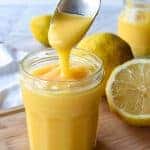

Homemade Lemon Curd Recipe
Find more recipes at marcellinaincucina.com
This Homemade Lemon Curd is tangy, thick, and delicious. Use lemon curd to top scones, fill cakes and tarts, or simply swirl through your morning yogurt. Makes 2 ½ cups (or 600ml).
Servings: 20 serves
Ingredients
- ½ cup lemon juice
- long strip of lemon rind with no white pith
- 6 ounces unsalted butter
- 1 cup granulated white sugar
- 3 eggs
- 2 egg yolks
Instructions
- In a medium saucepan place lemon juice, lemon rind, butter, and sugar. Heat, stirring occasionally, over medium heat until the butter has melted and the sugar has dissolved.½ cup lemon juice, long strip of lemon rind with no white pith, 6 ounces unsalted butter, 1 cup granulated white sugar
- In a bowl, place eggs and additional egg yolks and whisk until combined.3 eggs, 2 egg yolks
- Whisking the eggs, slowly pour in the lemon mixture. It is important to keep whisking while you do this.
- Strain the lemon curd mixture through a sieve back into the saucepan to remove any “eggy bits”.
- Cook over low heat until the mixture has thickened and coats the back of a spoon. At low heat, this can take as long as 10 minutes. If you are more experienced, use medium heat and it will take as little as 5 minutes.
- Be careful not to overheat and overcook the mixture – you will then have lemon-flavored scrambled eggs. I like to not risk further cooking of the curd by immediately placing the saucepan into ice water to stop any further cooking. Stir regularly while the curd cools. You could also pour the lemon curd into a bowl if the saucepan is particularly hot to stop overcooking.
- Once the mixture has cooled place in a sterilized jar and store in the fridge. Lemon curd will last for a couple of weeks in the fridge and it can be frozen.
Notes
For a tangier lemon curd:
- Add up to an additional 1/4 cup of lemon juice.
- Reduce the sugar slightly.
- Always use fresh lemon juice instead of bottled for the best flavor.
- Choose high-quality butter and free-range eggs to elevate the taste.
- Lemon juice can react with metals like aluminum, copper, and iron, so use a stainless steel saucepan for this recipe.
- To avoid scrambled eggs in your lemon curd, heat the mixture slowly over low heat. While a double boiler or a glass bowl over simmering water can help, this recipe works without one if you’re careful not to overheat and stay attentive. Don’t leave the curd unattended.
- Never let the curd boil. If it gets too hot, take the saucepan off the heat, stir thoroughly, and return it once the temperature lowers.
- Keep a large bowl of iced water nearby to cool the saucepan quickly if needed.
- Once the curd is done, transfer it to a bowl to cool. Leaving it in the saucepan risks overcooking.
Nutrition
Calories: 2325kcal | Carbohydrates: 211g | Protein: 24g | Fat: 160g | Saturated Fat: 95g | Cholesterol: 1247mg | Sodium: 227mg | Potassium: 391mg | Fiber: 1g | Sugar: 204g | Vitamin A: 5480IU | Vitamin C: 48mg | Calcium: 161mg | Iron: 3mg
