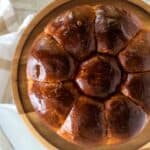

Portuguese Sweet Bread Recipe
Find more recipes at marcellinaincucina.com
This sweet Portuguese Bread is a luscious, soft bread from Portugal, enriched with butter and eggs. Often called Hawaiian Bread or Massa Sovada, this particular recipe, adapted from A Baker's Odyssey by Greg Patent, makes 2 loaves. Eat one fresh and freeze the other for later
Servings: 18 servings
Ingredients
Sponge
- ½ cup (65 grams) bread flour
- 2¼ teaspoons (7 grams) dry active yeast
- ½ cup (120 mls) warm water
Dough
- 6 tablespoons (3oz/85 grams) unsalted butter (at room temp)
- ½ cup (100 grams) granulated sugar
- finely grated zest of 1 lemon
- 1 teaspoon salt
- 3 large eggs (at room temp)
- ¼ cup (60 mls) milk (at room temp)
- 3 ½ cups (455 grams) bread flour (or as needed)
- 1 egg (extra) (beaten with 1 teaspoon water, for egg wash)
Instructions
To make sponge
- Mix together flour and dry active yeast then stir in warm water. Cover the bowl with plastic wrap and allow it to stand at room temperature for 60 minutes. It will rise and then fall back on itself. It should have a pleasant yeasty smell.
To make the dough
- In the bowl of a stand mixer combine the butter, sugar, lemon rind and salt and beat with a flat beater for 3 or 4 minutes.
- Scrape the bowl then add the eggs one at a time beating well after each. It will look curdled but that's ok.
- Mix in the milk and the sponge.
- Add all but 1 cup of the flour and beat on low. Increase the speed to medium and beat for 5 minutes.
- Switch to a dough hook. Add the remaining flour and knead on low speed for 5 more minutes until the dough is soft and supple.
- Oil your work surface with a little flavorless oil. Scrape the dough onto the oiled surface. Oil your hands as well. Flatten the dough into an oblong shape then fold in half. Turn the dough 90º then repeat the flattening and folding. Fold 6 times including the first folding. Form into a ball.
- Clean out the bowl and rub with a little oil. Place the dough into the bowl and turn over to coat with oil. Cover bowl with plastic wrap and allow the dough to rise for 2 hours.
- Divide the dough in half and then each half into 9 equal portions. Shape each portion into a ball.
- Coat two 8inch/20cm cake pans with non stick cooking spray. Arrange 9 balls of dough in each pan. Spray the tops of the dough lightly with cooking spray and cover loosely with plastic wrap. Allow to rise until doubled. This second rise will take about 1 hour.
- Preheat the oven to 350ºF/180ºC.
- Brush the loaves with egg wash and bake for 25-30 minutes or until the loaves are dark, golden brown and cooked through.
- Allow to cool for 5 minutes. Then gently tip the loaves out of the pans. Upturn and cool on wire racks.
Notes
Tips for Success
- Use fresh yeast. Even dried yeast can become stale and inactive.
- The sponge should be bubbly and frothy. If not, the yeast may be stale or the water too hot. Start again with fresh yeast or cooler water.
- Allow the dough to rise fully for a light, airy crumb.
- Rising time depends on room temperature. On warm days, it will rise faster, on cool days more slowly. Rely on visual cues rather than the clock.
- To speed up rising on a cool day, place the dough in a turned-off oven with a pan of hot water below, or set the bowl in a sink of warm water.
- This dough is meant to be sticky. Do not add extra flour. Use a little oil on your hands to fold and shape. It will become easier to handle as you work it.
- To shape rolls, cup your hand and roll gently on an unfloured surface, or pull the edges into the centre and pinch to seal.
Nutrition
Calories: 3143kcal | Carbohydrates: 473g | Protein: 89g | Fat: 98g | Saturated Fat: 52g | Cholesterol: 848mg | Sodium: 2658mg | Potassium: 971mg | Fiber: 14g | Sugar: 108g | Vitamin A: 3247IU | Calcium: 322mg | Iron: 8mg
